


Rep. Berg Wants Hunger to Be Impossible for Policymakers to Overlook
Food Lifeline has been fortunate to work with Rep. April Berg for years as a partner in advancing food security in Washington. From school meals to broader conversations about food access, agriculture and the social safety net, Berg has consistently helped elevate hunger as an issue of public policy.
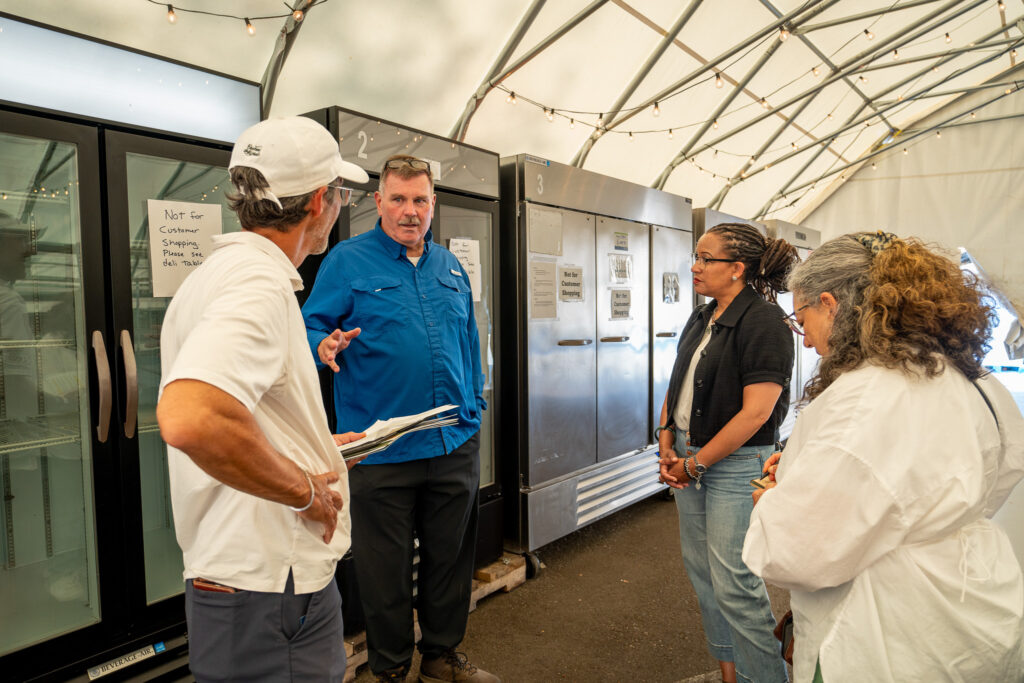
For our recent conversation, we met Berg at a place that grounds those policy discussions in the everyday reality of hunger: Mill Creek Food Bank—a local food bank in her district and a place where she has volunteered.
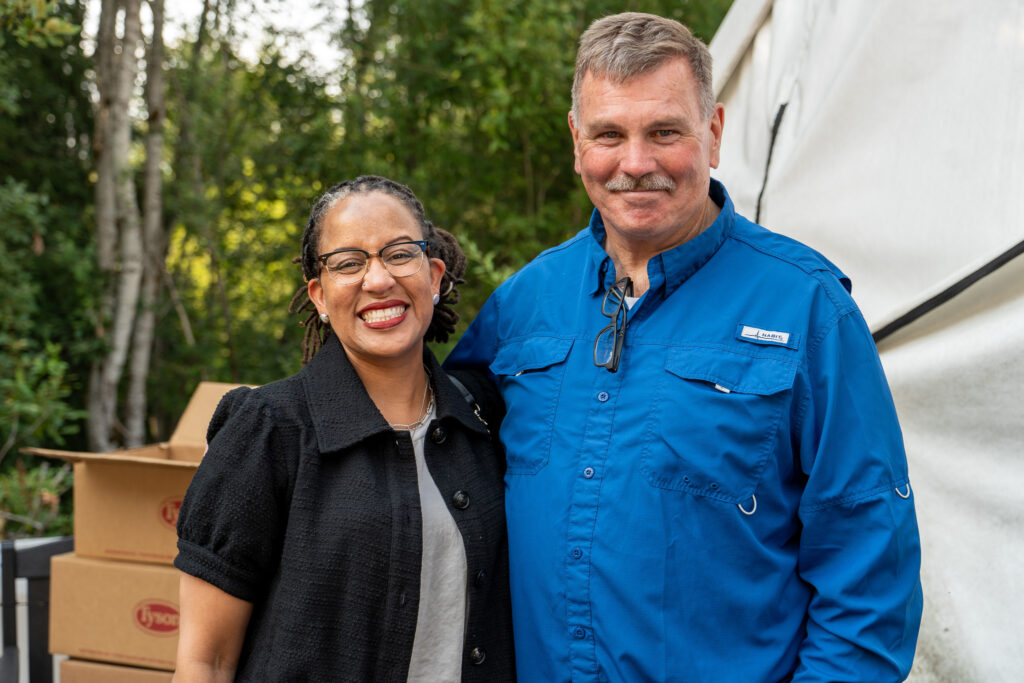
Against that backdrop, Berg reflected not simply on particular policies, but on what years of working on hunger—in her community and in the Legislature—have taught her. Four ideas in particular offer a window into how she thinks about food security and why she believes it deserves a more prominent place in public policy.
School meals are a whole-family economic and public health intervention
Berg’s commitment to school meals is rooted in her background in education and school boards. Early in her legislative career, one of the bills she was proudest to pass eliminated the copay families previously paid for reduced-price school lunches. She later became a persistent champion of universal school meals, introducing the proposal year after year.
But Berg’s argument for universal meals extends well beyond the school cafeteria.
“It honestly is a public health issue,” she told Food Lifeline.
Her reasoning starts at the family kitchen table. When parents no longer have to budget for their children’s breakfasts and lunches during the school week, those dollars do not disappear from the family’s food needs. They can instead help pay for dinner, weekend meals and other necessities.
In that sense, feeding a child at school can improve the food security of an entire household.
It also explains Berg’s enthusiasm for moving beyond income-based eligibility. She wants federal programs such as Community Eligibility to reach more schools, but she does not believe federal eligibility rules should determine Washington’s ultimate ambition.
For Berg, the state can make a simpler commitment: we are going to feed our kids.
That philosophy leads directly to a second, broader idea.
“We have to stop means testing food and hunger.”
Berg repeatedly returns to the reality that food insecurity is not limited to people who are unemployed. Many people experiencing hunger are working—and sometimes working a great deal.
She pointed to the contradiction of living in a wealthy, productive country where someone can work 40 or 50 hours a week and still experience food insecurity.
Modern employment makes traditional eligibility systems particularly problematic in her view.
Workers may move between jobs that pay more and jobs that pay less. Gig workers can have good months followed by bad ones. Family circumstances change. Food needs, however, remain constant.
“We have to stop means testing food and hunger. Everybody should be guaranteed three square meals a day, and we should have a social safety net that guarantees it when the jobs go.”
Her experience in her own community reinforces that point. Berg noted that perceptions of prosperity can make hunger particularly difficult to see in places like her district. People may assume “everybody’s fine here,” and that assumption can contribute to communities having fewer hunger-relief resources than they actually need.
But job loss, death, changing relationships and family circumstances can alter a household’s financial position rapidly.
That observation carries particular resonance sitting inside the Mill Creek Food Bank. Hunger does not observe assumptions about which ZIP codes or communities should need a food bank.
Food security, in Berg’s telling, therefore, should not be understood as a condition affecting a fixed group of “needy” people. It is part of the basic infrastructure that helps families withstand economic instability.
Bring food security to where people already are
A third idea comes from Berg’s experience during COVID.
The pandemic forced hunger-relief organizations and communities to abandon assumptions about how people were supposed to access food. Suddenly food was being distributed through churches, synagogues, mosques, after-school programs, tutoring programs and other community settings.
The lesson Berg took from that experience was simple: “We need to bring food to where people are.”
She believes that principle should extend beyond emergency food distribution. Conversations about food security—and the institutions and partnerships working to address it—should also exist in the places where people already gather.
For Food Lifeline and our network of food banks, food pantries and meal programs, it is an important observation. Effective hunger relief does not necessarily mean asking people to navigate a separate system created around hunger. Sometimes it means integrating food access into the trusted institutions and community spaces already woven into people’s lives.
Berg also sees food security as inseparable from other systems. She connects inadequate access to fresh food with economic and racial inequities, noting that communities underserved by grocery stores often overlap with communities already experiencing economic disadvantage.
Similarly, she sees opportunities to connect hunger relief more deliberately with Washington agriculture, food-waste reduction and the state’s emerging food-security work. Rather than treating farmers, surplus food, school nutrition and hunger relief as isolated policy areas, her comments point toward thinking of them as parts of one food system.
Why isn’t hunger treated like other major public issues?
Perhaps Berg’s most provocative insight came when Food Lifeline raised a challenge we encounter repeatedly: hunger is enormous in consequence, yet it can be surprisingly invisible in public debate.
Political conversations routinely center health care, housing, transportation and other fundamental needs. Hunger does not always make that list.
Berg offered a candid explanation.
Other major policy sectors have substantial economic interests organized around them. Health care has hospitals, insurers, pharmaceutical companies and other institutions with resources and government affairs operations. Housing has developers, builders, property interests and housing organizations. Those sectors have people whose job is to ensure policymakers continue talking about them.
Hunger is different.
“There’s nobody making any big system money off of food banks,” Berg observed.
Later she put the political consequence even more plainly: “You don’t have, you know, high paid government affairs teams focusing on it. That’s why it’s not top of mind.”
It is an important observation—and one that underscores why Food Lifeline believes advocacy is inseparable from our mission.
People experiencing hunger do not constitute an industry. A food pantry does not benefit financially when more people need its services. The charitable hunger-relief system exists precisely because communities have needs that markets and public systems have not adequately met.
That means hunger needs people and organizations willing to make it visible.
Berg has helped do that within the Legislature. She previously chaired the Legislature’s Food Fighters Caucus and remains involved as legislators increasingly coordinate food-related proposals rather than treating them as disconnected bills.
She also brings agriculture into that equation. Berg described listening closely to farmers about tax and regulatory barriers and helping translate those concerns into policy changes. To her, supporting farmers is connected to food security because farmers are producing the food communities depend upon.
There is also a fiscal argument Berg wants policymakers to consider more seriously. Rather than evaluating investments such as universal school meals only by what they cost in the state budget, she believes government should eventually measure what those investments save elsewhere—including potential improvements in health and reductions in other public costs.
From the local food bank to the Legislature
Taken together, Berg’s thinking presents food security not as a narrow social-service program, but as a thread running through family economics, education, health, agriculture and community well-being.
There was something particularly appropriate about having this conversation at Mill Creek Food Bank. Berg’s relationship with hunger relief exists at both ends of the policy spectrum: in a local food bank where neighbors come for food and where she volunteers, and in the Legislature where decisions are made about the systems and resources that shape whether families need that assistance in the first place.
That perspective has made her an important partner to Food Lifeline.
Our work together has included advancing school meals and elevating food security within broader policy conversations. But perhaps the most important common ground is the belief underlying all of it: hunger should not be accepted as inevitable, nor should it remain invisible.
Ending hunger requires feeding people today. It also requires changing the policies and systems that determine whether families have enough tomorrow.
Food Lifeline is grateful to Rep. Berg for understanding both sides of that mission—and for years of partnership in pursuing them.