


2026 Washington State Legislative Session Update: Statewide Food Security Strategy
Policies and investments to align food security strategies across state agencies.
See Food Lifeline’s complete 2026 State Advocacy Agenda here.
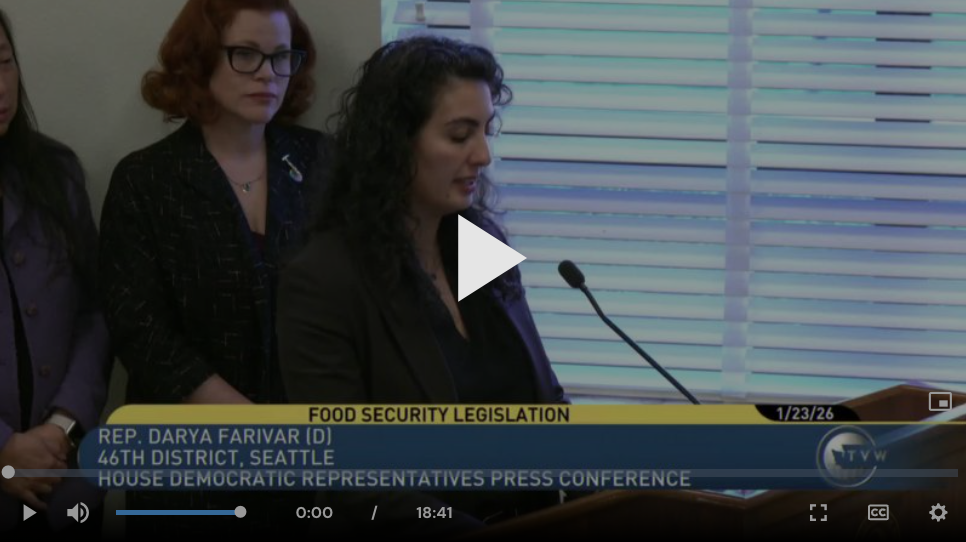
See state lawmakers’ press conference about food security bills here:
HB 2238, Statewide Food Security Strategy, Rep Kristine Reeves.
A new proposal to expand the Washington State Department of Agriculture’s responsibilities to include statewide food security coordination and food system performance tracking and directs WSDA to work with stakeholders and other agencies to create a comprehensive “Statewide Food Security Strategy” plan. This bill will serve as the capstone for several policy proposals which aim to organize, support, and reinforce food security efforts in Washington state.
- Key takeaway: “This bill provides the coordination, accountability, and data-driven approach needed to align food security efforts across state agencies. A comprehensive statewide strategy is essential for reducing hunger efficiently and equitably.”
HB 2463, Washington Farmers Feeding Families Act, Rep Kristine Reeves.
A new proposal would formally merge two existing statewide programs that source Washington‑grown food and support local farmers, growers, and producers into a single law.
- Farm to Food Pantry – Strengthens community-based food systems by providing up front funding, contract models, and administrative support to nonprofit hunger relief organizations to facilitate direct purchasing from local, small-scale farmers.
- Washington Farm Donation Program (formerly Washington Commodity Donation Program) – Expands partnerships and opens new market opportunities for Washington farmers by funding grants that support donating surplus produce, grains, dairy, and protein to hunger relief organizations.
- Key takeaway: “By strengthening and unifying programs that connect Washington farmers with hunger-relief organizations, this bill supports local agriculture while increasing access to fresh, nutritious food for families facing hunger.”
HB 2369, Farm to School, Rep Kristine Reeves.
A new program to boost schools’ access to Washington‑grown foods by supporting local purchasing and improving distribution to school meal programs.
- Key takeaway: “This bill improves child nutrition, supports local producers, and strengthens school meal programs by expanding access to Washington-grown foods. It is an important investment in both health and education.”
HB 2616, State Farm Bill, Rep Kristine Reeves.
The proposal strengthens regional agricultural infrastructure by supporting local production, processing, and distribution, while investing in information‑sharing, capital projects, and farmland protection and conservation easements.
- Key takeaway: “Investing in regional agricultural infrastructure and farmland protection strengthens the resilience of Washington’s food system and supports long-term food security.”
HB 2297, Grocery Access, Rep Darya Farivar.
A new proposal to preserve existing grocery stores and support the development and retention of grocery stores in underserved communities where market forces alone have not met community needs.
- Key takeaway: “Preserving and expanding grocery access in underserved communities addresses a fundamental barrier to food security and promotes health equity.”
HB 2211, Medically tailored meals, Rep Kristine Reeves.
The bill requires that medically tailored meals for Medicaid enrollees come from Washington‑based nonprofit providers whenever possible and meet established nutritional standards.
- Key takeaway: “Integrating medically tailored meals into Medicaid supports better health outcomes, lowers healthcare costs, and recognizes food as a critical component of care.”
SB 6006, Exempting food banks from the retail sales tax imposed on certain services, Sen Chris Gildon.
Explicitly exempts food banks from retail sales tax on certain procurement of tangible personal property and services used in their charitable operations.
- Key takeaway: “Exempting food banks from certain sales taxes ensures that more charitable resources go directly to feeding people rather than administrative costs.”